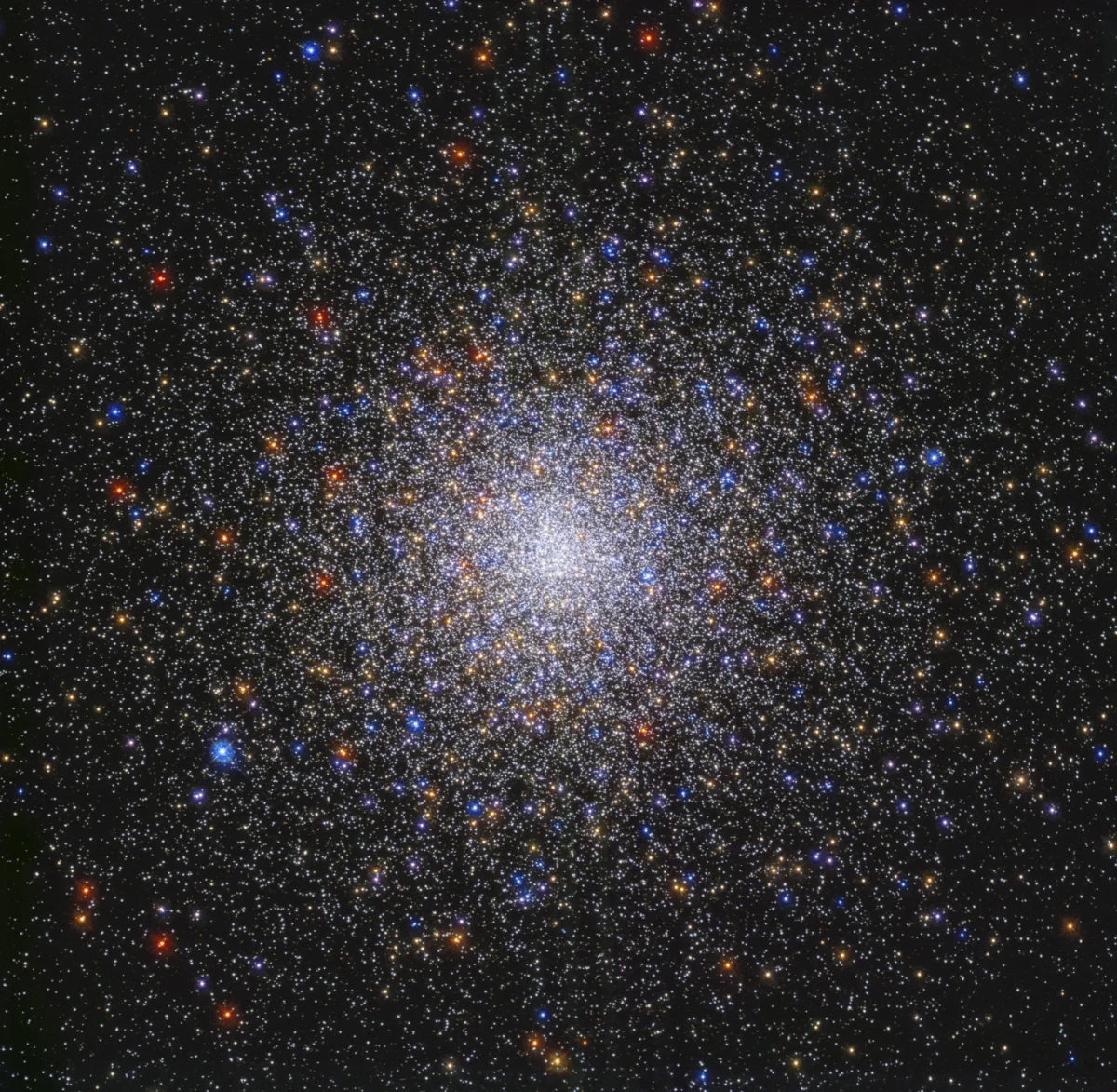
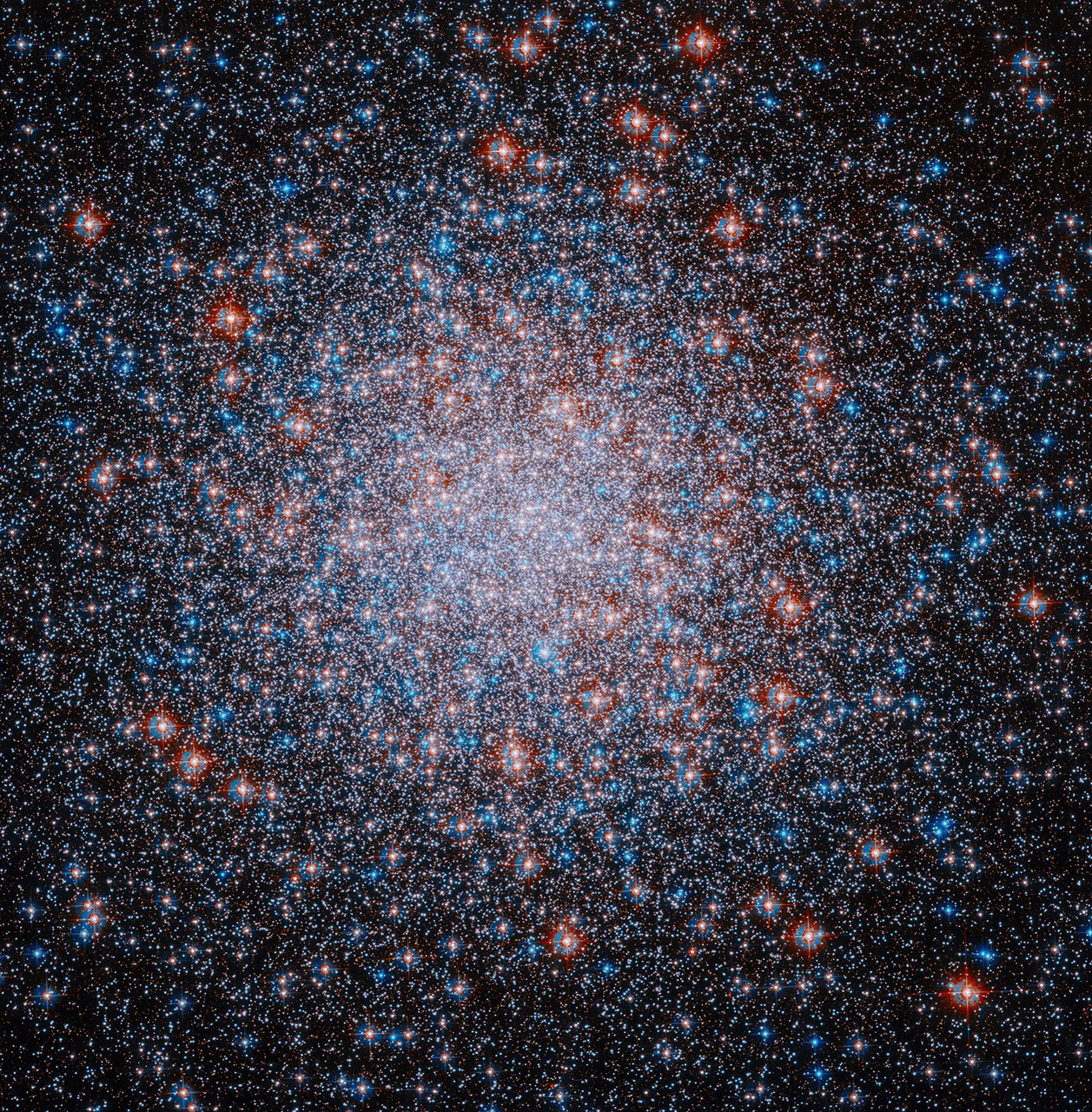
In a spectacular celestial tribute, NASA’s Hubble Space Telescope has unveiled an awe-inspiring image of Messier 3 (M3), a colossal globular cluster brimming with over half a million stars, painted in a vibrant palette of red, white, and blue. This breathtaking vista, released in anticipation of the United States’ 250th anniversary in 2026, offers a profound glimpse into the ancient architecture of our Milky Way galaxy. M3, also cataloged as NGC 5272, stands as one of the galaxy’s most massive and enigmatic stellar congregations, a testament to the enduring power of gravity and the vast timescales of cosmic evolution.
A Glimpse into Galactic History
Globular clusters, like M3, are essentially time capsules, comprised of ancient stars that coalesced from the same primordial cloud of gas and dust billions of years ago. This shared origin imbues them with remarkably similar ages and chemical compositions, making them invaluable for understanding the early universe and the formation of galaxies. Our Milky Way galaxy is adorned with approximately 150 known globular clusters, predominantly scattered throughout its outer halo, each a silent witness to eons of cosmic history.
The significance of M3 extends beyond its sheer mass. It occupies a unique position in the galactic landscape, situated relatively far from the dense, crowded core of the Milky Way. This isolation, coupled with its rich stellar population, has made it a focal point for astronomical research. Notably, M3 boasts an exceptional abundance of RR Lyrae variable stars – over 240 have been identified, more than in any other globular cluster in our galaxy.
RR Lyrae Variables: Cosmic Yardsticks and Ancient Survivors
RR Lyrae variables are a class of pulsating stars that represent some of the oldest stellar inhabitants of the Milky Way. Their importance to astronomers lies in their predictable and well-understood behavior. As these stars pulsate, their brightness waxes and wanes over a regular period. Crucially, this fluctuation reveals their intrinsic luminosity – their true, inherent brightness. By comparing this true brightness to their observed apparent brightness from Earth, astronomers can accurately calculate their distance. This method, akin to using headlights to gauge the distance of an approaching car, has been a cornerstone of extragalactic distance measurements for decades. The sheer number of RR Lyrae stars in M3 provides astronomers with a robust dataset for refining these distance calculations and for probing the cluster’s evolutionary history.
The Enigma of Blue Stargglers
Adding another layer of intrigue to M3’s stellar population are approximately 70 identified "blue straggler" candidates. These are stars that, contrary to the expected reddish hue of ancient stars in a globular cluster, shine with a brilliant blue light. This coloration suggests they are much younger and hotter than their reddish neighbors. The discovery of blue stragglers in M3 was a groundbreaking observation, as it was the first globular cluster where these peculiar stellar objects were definitively identified.
The prevailing scientific hypothesis for the existence of blue stragglers is that they are the result of stellar collisions or mass transfer events. In the dense environment of a globular cluster, stars can interact gravitationally. A smaller, less massive star may be stripped of its outer layers by the stronger gravitational pull of a more massive companion, effectively rejuvenating it and causing it to appear bluer and younger. Alternatively, two stars could merge, creating a single, more massive and hotter star. These processes, while seemingly violent, contribute to the complex and dynamic nature of globular clusters.
A Galactic Merger Hypothesis
The unusual characteristics of M3, including its distinct stellar populations and the presence of a high number of blue stragglers, have led astronomers to propose a compelling theory about its origins. It is speculated that M3 may not be a single, primordial globular cluster, but rather the remnant of a galactic merger. The theory suggests that two distinct globular clusters, each with their own unique stellar populations, once orbited each other within a smaller dwarf galaxy. This dwarf galaxy was subsequently engulfed and assimilated by the much larger Milky Way. The gravitational forces and chaotic environment of this merger would have influenced the evolution of the stars within these original clusters, potentially explaining the anomalies observed in M3 today. This scenario highlights the dynamic and often violent history of galactic evolution, where larger galaxies grow by consuming their smaller companions.
Hubble’s Enduring Legacy and Future Endeavors
The Hubble Space Telescope, with its unparalleled resolution and sensitivity, has provided multiple detailed images of M3 over its illustrious career, meticulously documenting its intricate features. In the released image, the colors are not merely aesthetic but scientifically informative. Blue hues represent shorter wavelengths of visible light, indicating hotter stars, while red tones depict longer wavelengths of visible light and some near-infrared radiation, signaling cooler stars. These color assignments are determined through standard image processing techniques that map the light captured by Hubble’s filters to specific colors, offering a visual representation of the stars’ temperatures and compositions.
This latest observation of M3 is part of a broader Hubble Treasury program. This ambitious initiative aims to survey approximately half of the Milky Way’s globular clusters, building a comprehensive chronological record of how our galaxy formed and evolved. By studying these ancient stellar congregations, astronomers can piece together the grand narrative of galactic assembly, from its nascent stages to its current majestic form.
With over three decades of continuous operation, Hubble remains one of NASA’s flagship observatories, a testament to human ingenuity and scientific perseverance. Its observations are not conducted in isolation but are intricately woven into a larger tapestry of cosmic exploration, complementing the work of other cutting-edge space missions. The infrared capabilities of the James Webb Space Telescope and the wide-field surveys planned for the upcoming Nancy Grace Roman Space Telescope will further enhance our understanding of the universe, working in tandem with Hubble to provide a more complete and nuanced picture of our vast cosmic home.
A Chronology of Discovery and Observation
The scientific journey with Messier 3 is a long and ongoing one, with key milestones in its study:
- 1784: Charles Messier catalogs M3, noting it as a faint nebula.
- Late 19th – Early 20th Century: Early photographic plates reveal M3 to be a globular cluster, with its true nature gradually understood.
- Mid-20th Century: Astronomers begin to identify variable stars within M3, laying the groundwork for its use as a distance indicator.
- 1970s – 1980s: The identification of "blue stragglers" in M3 revolutionizes the understanding of stellar evolution within globular clusters.
- 1990s onwards: Hubble Space Telescope observations provide unprecedented detail, allowing for precise measurements of stellar properties, kinematics, and the identification of multiple stellar populations, supporting the galactic merger hypothesis.
- Present Day: Ongoing Hubble Treasury program surveys continue to leverage M3 as a key benchmark for understanding galactic evolution and the properties of globular clusters.
Supporting Data and Scientific Implications
The data gleaned from M3 offers significant insights:
- Mass Estimation: M3 is estimated to contain approximately 500,000 solar masses, placing it among the most massive globular clusters known in the Milky Way.
- RR Lyrae Population: The presence of over 240 RR Lyrae variables provides a statistically significant sample for distance calibrations. Their average distance from Earth is approximately 33,600 light-years.
- Blue Straggler Candidates: The identification of around 70 blue straggler candidates suggests a high rate of dynamical interactions within the cluster, supporting theories of stellar collisions and mass transfer.
- Stellar Population Diversity: Spectroscopic analysis reveals at least two distinct populations of stars within M3, characterized by different chemical abundances, which strongly supports the merger hypothesis.
The implications of studying M3 are far-reaching. Understanding the formation and evolution of globular clusters like M3 is crucial for:
- Calibrating Cosmic Distances: The precise distances derived from RR Lyrae stars in M3 contribute to the cosmic distance ladder, essential for measuring the size and expansion rate of the universe.
- Testing Stellar Evolution Models: The presence of blue stragglers and the diverse stellar populations provide stringent tests for our theoretical models of how stars form, interact, and age.
- Reconstructing Galactic History: Globular clusters are relics of the early Milky Way. Studying their properties helps astronomers piece together the timeline of galactic mergers and the build-up of our galaxy over billions of years.
- Understanding Galaxy Formation: The proposed merger origin of M3 offers a tangible example of how dwarf galaxies are accreted by larger galaxies, a fundamental process in the hierarchical model of galaxy formation.
Official Statements and Future Outlook
While no specific public statements were released in conjunction with this particular image release, the ongoing work of the Hubble Mission Team at NASA’s Goddard Space Flight Center underscores the continuous dedication to unraveling the universe’s mysteries. The NASA Hubble Mission Team, comprised of scientists and engineers, is responsible for the planning, execution, and data analysis of Hubble’s observations. Their work, exemplified by this stunning image and the scientific investigations it represents, is vital for advancing our knowledge of the cosmos.
Claire Andreoli, a representative from NASA’s Goddard Space Flight Center, typically serves as a media contact for such releases, facilitating the dissemination of scientific discoveries to the public. The continued operation of Hubble, alongside the upcoming capabilities of the Roman Space Telescope, promises a future rich with astronomical discoveries, further illuminating the complex and awe-inspiring universe we inhabit. The legacy of Hubble, in capturing such iconic celestial scenes and driving fundamental scientific inquiry, will undoubtedly inspire generations of astronomers and space enthusiasts alike.