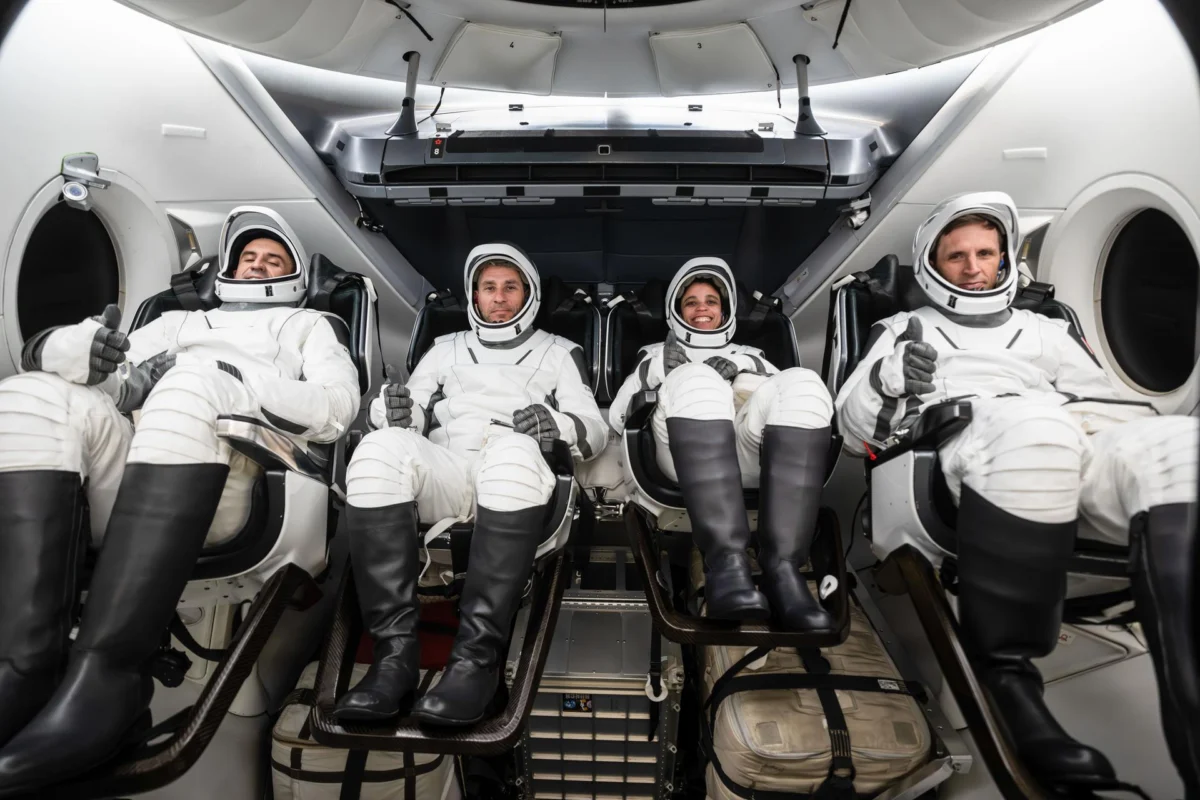
NASA and its international partners are poised to unveil crucial details regarding the upcoming SpaceX Crew-13 mission to the International Space Station (ISS). The agency will host two distinct news conferences on Monday, August 3, originating from NASA’s Johnson Space Center in Houston. These briefings are set to provide a comprehensive overview of the mission’s objectives, introduce the highly anticipated crew, and outline their rigorous preparations for their journey to the orbiting laboratory. This marks the final media engagement for the Crew-13 astronauts before they embark on their journey to NASA’s Kennedy Space Center in Florida, the launch site for their historic endeavor.
Mission Overview and Crew Preparations Take Center Stage
The day’s proceedings will commence at 12 p.m. EDT with a Mission Overview News Conference. This session will be led by mission leadership, who will meticulously detail the scientific goals, technological advancements, and operational strategies underpinning the Crew-13 mission. Attendees can anticipate a thorough explanation of the mission’s unique contributions to space research and exploration, as well as the logistical choreography involved in orchestrating a human spaceflight endeavor. This overview is critical for understanding the broader context of the ISS program and its ongoing significance in advancing humanity’s understanding of space and our place within it.
Following this comprehensive mission briefing, at 2 p.m. EDT, the focus will shift to the Crew-13 News Conference. This segment will directly feature the four astronauts selected to undertake this critical rotation. They will share personal insights into their extensive training regimens, their individual roles and responsibilities aboard the ISS, and their personal preparations for living and working in microgravity. This is a unique opportunity for the public and media to connect with the individuals who will represent their nations and the global space exploration community aboard the ISS. Their experiences and perspectives will offer a compelling human element to the technical and scientific aspects of the mission.
Both news conferences will be broadcast live by NASA, allowing a global audience to follow the proceedings in real-time. Interested viewers can access the live streams via the NASA website at https://www.nasa.gov/live.
A Diverse and Experienced Crew Readies for the Cosmos
The Crew-13 mission is slated to carry a distinguished quartet of astronauts and cosmonauts to the International Space Station. The crew includes NASA astronauts Jessica Watkins and Luke Delaney, Canadian Space Agency (CSA) astronaut Joshua Kutryk, and Roscosmos cosmonaut Sergey Teteryatnikov. This multinational collaboration underscores the spirit of international cooperation that is fundamental to the success of the ISS program.
Their journey to the orbiting laboratory is scheduled to commence aboard a SpaceX Dragon spacecraft, propelled by the company’s reliable Falcon 9 rocket. The launch is anticipated from Space Launch Complex 40 at Cape Canaveral Space Force Station in Florida, with the earliest possible launch window set for mid-September. This launch will represent another significant milestone in NASA’s Commercial Crew Program, which has revolutionized access to space for American astronauts.
Media Accreditation and Participation
Media representatives seeking to cover these pivotal announcements have specific deadlines for accreditation. International media intending to attend the news conferences in person must submit their requests to the NASA Johnson newsroom at [email protected] by 5 p.m. EDT on Tuesday, July 21. U.S.-based media have until 5 p.m. EDT on Thursday, July 30, to respond. For those opting for virtual participation, responses are required by 10 a.m. EDT on the day of the event. NASA’s agency-wide media accreditation policy is readily available online for review.
Following the formal news conferences, a limited number of one-on-one media interviews with the crew members will be available. All requests for these interviews must be submitted to the NASA Johnson newsroom at [email protected] by 5 p.m. EDT on July 30.
In-Depth Biographies of the Crew
Jessica Watkins: A Return to Orbit with Extensive Experience
NASA astronaut Jessica Watkins is no stranger to the International Space Station. Selected as a NASA astronaut in 2017, Watkins brings a wealth of experience to her second mission aboard the orbiting laboratory. Her journey to space began with NASA’s SpaceX Crew-4 mission in 2022, where she spent a remarkable 170 days in orbit, contributing to Expeditions 67 and 68. This upcoming mission will make her the first NASA astronaut to launch aboard a SpaceX Dragon spacecraft on two separate occasions, highlighting her pivotal role in the agency’s human spaceflight endeavors.
Watkins’ background is deeply rooted in science. She grew up in Lafayette, Colorado, and earned an undergraduate degree in Geological and Environmental Sciences from Stanford University. Her academic pursuits culminated in a Ph.D. in Geology from the University of California, Los Angeles. Her expertise as a geologist, particularly her studies of the Martian surface and her involvement with the Curiosity rover science team at NASA’s Jet Propulsion Laboratory, provides a unique scientific perspective that she will undoubtedly bring to her work on the ISS. Her previous experience on the space station, coupled with her scientific acumen, positions her as a valuable asset to the Crew-13 mission.
Luke Delaney: A Naval Aviator’s First Voyage to Space
For Luke Delaney, the Crew-13 mission represents his inaugural flight into space. Selected as a NASA astronaut in 2021, Delaney’s professional trajectory has been marked by distinction. He holds a bachelor’s degree in Mechanical Engineering from the University of North Florida and a master’s degree in Aerospace Engineering from the Naval Postgraduate School. A decorated naval aviator, Delaney has participated in numerous exercises across the Asia Pacific region and contributed to missions supporting Operation Enduring Freedom.
His expertise extends to the realm of test piloting, where he has evaluated developmental aircraft systems and served as a test pilot instructor. Prior to his astronaut selection, Delaney also contributed to airborne science missions as a research pilot at NASA’s Langley Research Center in Hampton, Virginia. This diverse background, encompassing military aviation, test piloting, and scientific support, provides him with a robust skill set essential for the demands of spaceflight.
Joshua Kutryk: Canadian Expertise in Space Exploration
Canadian Space Agency astronaut Joshua Kutryk is set to make his first journey to the International Space Station with the Crew-13 mission. Selected as a CSA astronaut in 2017, Kutryk boasts an impressive military career. He served as a CF-18 fighter pilot, undertaking missions in support of Canada’s commitments to NATO, the United Nations, and the North American Aerospace Defense Command (NORAD).
A native of Fort Saskatchewan, Alberta, Kutryk’s technical prowess is equally notable. He has experience as an experimental and operational test pilot at the Aerospace Engineering Test Establishment in Cold Lake, Alberta. His academic achievements include a bachelor’s degree in Mechanical Engineering from the Royal Military College of Canada, and he is a distinguished graduate of the United States Air Force Test Pilot School at Edwards Air Force Base, California. Furthermore, Kutryk holds master’s degrees in Space Studies, Flight Test Engineering, and Defense Studies, underscoring his comprehensive understanding of aerospace principles and operations.
Sergey Teteryatnikov: Russian Cosmonaut’s Debut Mission
The Crew-13 mission will also mark the first spaceflight for Roscosmos cosmonaut Sergey Teteryatnikov. Teteryatnikov graduated from the Naval Academy in St. Petersburg, Russia, in 2011, specializing in ship power plant operations. His career has been focused on naval engineering, including extensive experience with undersea vessels and specialized engine room operations.
He was selected for the prestigious Gagarin Research and Test Cosmonaut Training Center Cosmonaut Corps in 2021 and has been actively serving as a test cosmonaut since 2023. His background in complex engineering systems and his training as a test cosmonaut are vital qualifications for his upcoming role on the ISS.
Historical Context and the Future of ISS Operations
The International Space Station, a marvel of engineering and international collaboration, has been continuously inhabited since November 2, 2000. It serves as a unique microgravity laboratory for scientific research across a multitude of disciplines, including biology, human physiology, physics, materials science, and Earth observation. The ongoing crew rotation missions are the lifeblood of the station, ensuring continuous scientific operations and the maintenance of this vital outpost in space.
NASA’s partnership with SpaceX through the Commercial Crew Program has been instrumental in restoring U.S. human launch capability and increasing access to the ISS. Crew-13’s mission continues this legacy, further solidifying the capabilities of commercial providers in supporting human spaceflight. The successful execution of such missions not only advances scientific knowledge but also provides invaluable experience and technology development crucial for future deep space exploration endeavors, such as NASA’s Artemis program, which aims to return humans to the Moon and eventually send them to Mars.
Implications for Scientific Advancement and International Relations
The Crew-13 mission, with its diverse international crew, reinforces the critical role of the ISS as a platform for global scientific collaboration. The experiments conducted and data gathered during their tenure will contribute to a deeper understanding of life in space, the effects of long-duration spaceflight on the human body, and potentially lead to breakthroughs in medicine, materials science, and other fields that can benefit life on Earth.
Furthermore, the continued success of joint missions between NASA, CSA, and Roscosmos on the ISS serves as a powerful symbol of international cooperation in an era where such partnerships are more important than ever. These collaborations transcend political boundaries, demonstrating the shared human aspiration to explore the cosmos and push the frontiers of knowledge. The seamless integration of astronauts and cosmonauts from different nations into a cohesive and effective crew highlights the robust diplomatic ties fostered through space exploration.
Additional Mission Information
For those seeking more in-depth information about the Crew-13 mission, NASA has dedicated a comprehensive resource page available at: https://www.nasa.gov/mission/nasas-spacex-crew-13. This site will be regularly updated with mission details, crew biographies, and scientific objectives.
The upcoming news conferences on August 3 will undoubtedly provide a clearer picture of the exciting scientific and operational endeavors that await the Crew-13 astronauts. As they prepare for their journey, the world watches with anticipation, eager to witness the continuation of humanity’s bold exploration of the final frontier.