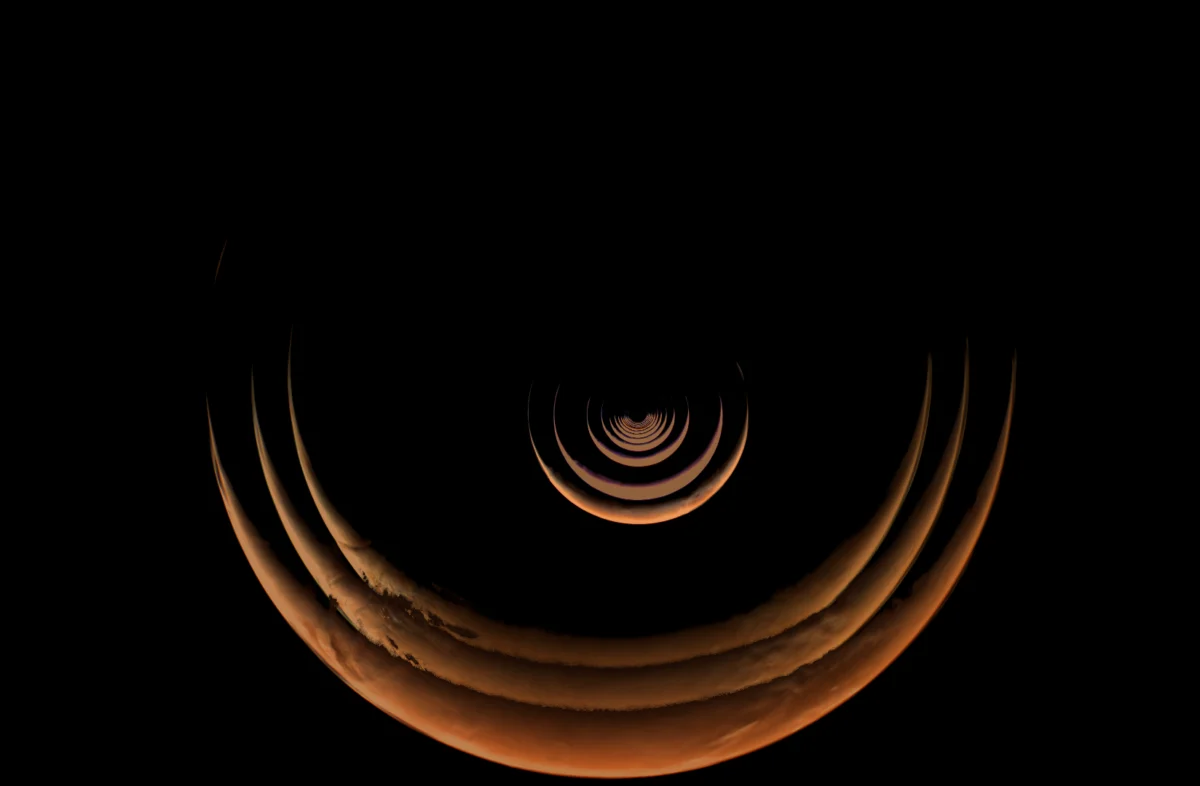
The journey of NASA’s Psyche mission has offered a breathtaking new perspective on the Red Planet, with a recently released composite of images showcasing the waxing crescent of Mars as the spacecraft executed a crucial gravity assist maneuver. Captured between May 2 and May 15, 2026, these images meticulously document the spacecraft’s approach to Mars, illustrating the planet’s growing illuminated face from the perspective of the approaching probe. This visual narrative, compiled by the Psyche mission team, provides a unique glimpse into the dynamic celestial ballet of interplanetary travel and the scientific data gathered during this critical phase of the mission.
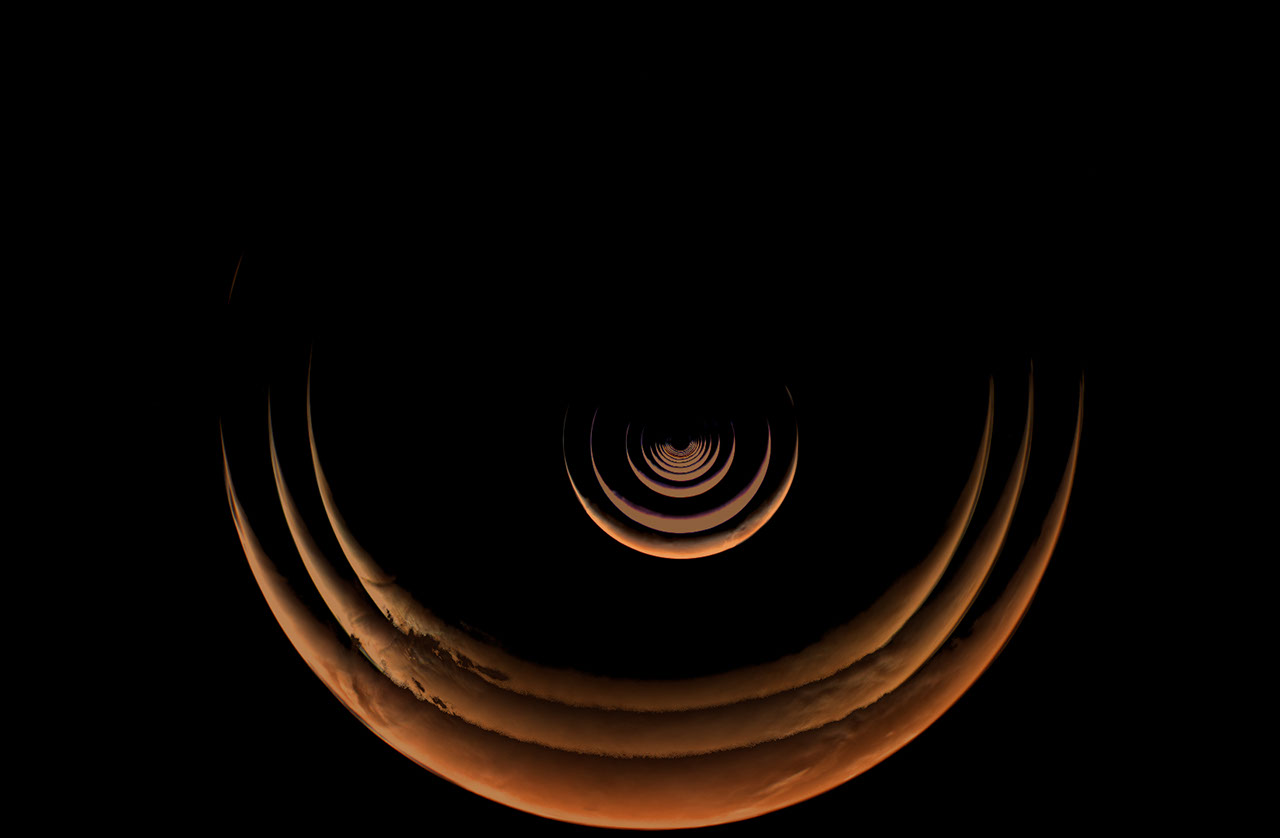
The composite image, set against a stark black background, features a series of concentric, glowing orange crescent planetary horizons. These crescents expand outward from a small central point, symbolizing the spacecraft’s increasing proximity to Mars. The series commences with the smallest, most distant crescent at the image’s core, progressively enlarging as the spacecraft closes the vast expanse of space. This visual progression highlights the precision of orbital mechanics and the meticulous planning required for such interplanetary endeavors. After these initial observations, Mars began to dominate the field of view of the spacecraft’s multispectral imager, culminating in a series of high-resolution images of the Martian surface as Psyche made its closest approach.
The Science Behind the Approach: Gravity Assists and Orbital Mechanics
The technique employed by the Psyche mission to leverage Mars’ gravitational pull is known as a gravity assist, or gravitational slingshot. This maneuver is a fundamental tool in spacecraft trajectory planning, allowing missions to gain or shed velocity and alter their course by "borrowing" a small amount of a planet’s orbital energy. For the Psyche mission, the gravity assist around Mars was essential for refining its trajectory towards its ultimate destination: the metal-rich asteroid 16 Psyche, located in the main asteroid belt between Mars and Jupiter.
The approach to Mars from a high phase angle, as observed by Psyche, meant that the planet appeared as a thin crescent. A phase angle refers to the angle between the Sun, the observed body (Mars), and the observer (the spacecraft). When this angle is large, the illuminated portion of the body visible to the observer is significantly reduced, resulting in a crescent phase, much like the phases of Earth’s Moon. As Psyche drew nearer, the phase angle changed, and a greater portion of Mars became illuminated from the spacecraft’s vantage point, leading to the progressively larger crescents depicted in the composite.
The multispectral imager instrument aboard the Psyche spacecraft played a pivotal role in capturing these detailed images. This instrument is designed to capture light across various wavelengths, allowing scientists to analyze the composition and physical properties of celestial bodies. While the primary objective of the Mars flyby was to gain scientific data and perform the gravity assist, the opportunity to capture such visually striking imagery adds an invaluable dimension to public engagement and scientific understanding.
A Chronology of the Mars Encounter
The period of observation and the gravity assist maneuver around Mars spanned approximately two weeks in May 2026, a meticulously planned sequence of events:
- Early May 2026 (May 2 onwards): The Psyche spacecraft begins its approach to Mars. From this distance, with a high phase angle, Mars appears as a small, thin crescent in the spacecraft’s multispectral imager. This marks the beginning of the time-lapse sequence, with the smallest crescent representing the farthest point of observation during this phase.
- Mid-May 2026 (May 2 – May 15): As Psyche continues its trajectory, the distance to Mars decreases, and the phase angle shifts. The multispectral imager captures a series of images, each showing a progressively larger illuminated portion of Mars. This period constitutes the core of the time-lapse, illustrating the visual expansion of the Martian crescent.
- Close Approach (Mid-May 2026): At the point of closest approach, Mars begins to "overfill" the field of view of the imager. This indicates that the spacecraft is now in close proximity, and the mission team transitions to capturing high-resolution imagery of the Martian surface. While the crescent imagery ceases as Mars becomes a full disk from the spacecraft’s perspective, this phase is crucial for obtaining detailed surface data.
- Post-Encounter (After Mid-May 2026): Following the gravity assist and close flyby, Psyche continues on its trajectory toward the asteroid belt. The data collected during the Mars encounter, including the imagery and any scientific readings, is processed and analyzed by the mission team.
The culmination of these observations resulted in a "stunning time-lapse" of the entire Mars encounter, as described by the Psyche team. This video compilation offers a dynamic and engaging way to understand the complex orbital maneuvers and the visual transformation of Mars from the spacecraft’s perspective.
Supporting Data and Mission Objectives
The Psyche mission is a flagship endeavor by NASA, aimed at exploring a unique, metal-rich asteroid named 16 Psyche. This asteroid, believed to be the exposed nickel-iron core of an early planetesimal, offers a rare opportunity to study the interiors of rocky planets, including our own. Understanding the composition and formation of 16 Psyche could provide invaluable insights into the processes that shaped the terrestrial planets in our solar system.
The gravity assist from Mars was not merely a navigational step but a critical component for conserving fuel and achieving the precise trajectory needed to reach 16 Psyche. The mission launched in October 2023, and its journey to the asteroid belt is projected to take several years. The Mars flyby serves as a crucial milestone in this extended voyage.
The multispectral imager, by capturing images in various wavelengths, can reveal details about the surface composition of Mars, even from a distance. While the primary scientific objectives of the Psyche mission are focused on asteroid 16 Psyche, any additional data gathered on planets or moons encountered along the way is considered a valuable bonus. The imagery of the Martian crescent, while visually captivating, also represents a record of the spacecraft’s navigation and the capabilities of its instruments.
Official Responses and Scientific Analysis
The release of the Mars flyby imagery has been met with enthusiasm from the scientific community and the public alike. Dr. Lindy Elkins-Tanton, the principal investigator of the Psyche mission, has consistently highlighted the educational and inspirational value of such visual data. While specific statements regarding this particular composite were not immediately available at the time of this report, the Psyche team has a history of actively engaging with the public through its website and social media channels, sharing key mission milestones and discoveries.
The compilation of these images into a time-lapse video demonstrates the sophisticated data processing capabilities of the mission control teams at NASA’s Jet Propulsion Laboratory (JPL) and the scientific teams at institutions like Arizona State University (ASU), which is leading the mission. The ability to synchronize and present such a sequence of images underscores the precision with which these interplanetary missions are managed.
Broader Impact and Implications
The visual narrative of Mars presented by the Psyche mission has far-reaching implications beyond the immediate scientific gains.
- Public Engagement and STEM Education: Striking imagery from space missions has a profound ability to capture the public’s imagination, inspiring interest in science, technology, engineering, and mathematics (STEM) fields. The time-lapse of the Martian crescent serves as a powerful educational tool, illustrating complex concepts like orbital mechanics, gravity assists, and planetary phases in an accessible and engaging manner.
- Technological Advancement: The success of missions like Psyche is a testament to ongoing advancements in spacecraft design, propulsion systems, navigation, and instrument technology. The multispectral imager, capable of capturing detailed imagery throughout the mission, represents cutting-edge technology that pushes the boundaries of our observational capabilities.
- Future Exploration: Each successful flyby and gravity assist maneuver provides invaluable data and operational experience that informs future interplanetary missions. The techniques refined during the Psyche mission’s Mars encounter will undoubtedly be leveraged by future spacecraft venturing into the solar system.
- Understanding Our Solar System: By studying celestial bodies like the asteroid 16 Psyche and gaining new perspectives on planets like Mars, humanity deepens its understanding of the formation and evolution of our solar system. These missions contribute to a grander narrative of cosmic history, helping us contextualize Earth’s place within the vastness of space.
The NASA/JPL-Caltech/ASU credit associated with the image signifies the collaborative nature of space exploration, involving multiple institutions and dedicated professionals. The continued exploration of space, exemplified by the Psyche mission’s journey and its captivating encounters with celestial bodies, remains a vital endeavor for scientific discovery, technological innovation, and inspiring future generations of explorers. The visual journey of Mars through the eyes of the Psyche spacecraft is a powerful reminder of humanity’s persistent drive to explore the cosmos.
For those interested in learning more about NASA’s Psyche mission and its ongoing journey, the official mission website at https://science.nasa.gov/mission/psyche/ provides a comprehensive resource for updates, scientific findings, and mission details.