In the United States, the legal landscape governing the right of individuals with felony convictions to seek elected office remains a complex, contradictory, and often opaque patchwork of state and local statutes. While the U.S. Constitution imposes no such restrictions on federal officeholding—allowing individuals with felony records, and even those currently incarcerated, to run for the presidency or a seat in Congress—the rules for state and local positions vary significantly across the 50 states, the District of Columbia, and U.S. territories. This disparity creates a system where an individual’s eligibility to represent their community often depends less on their qualifications or the will of the voters, and more on the specific jurisdiction in which they reside.
The Constitutional and Legal Landscape
The foundational precedent for federal office eligibility was established in the 1995 Supreme Court case U.S. Term Limits, Inc. v. Thornton. The Court held that states are prohibited from imposing additional qualifications for federal office beyond those explicitly outlined in the U.S. Constitution. Consequently, a felony conviction does not legally bar a candidate from seeking a seat in the U.S. Senate or the House of Representatives, nor does it prevent an incarcerated person from mounting a presidential campaign.
Historically, this federal standard has seen notable applications. In 1798, Vermont Congressman Matthew Lyon was reelected while serving a sentence under the Sedition Act. More than a century later, in 1920, socialist leader Eugene V. Debs captured nearly a million votes for president while incarcerated, campaigning under the moniker "Convict 9653." More contemporary figures, such as Lyndon LaRouche and Leonard Peltier, also sought the presidency from behind bars.
However, state and local governments operate under a different set of legal frameworks. State constitutions and statutes frequently grant local bodies the authority to impose stricter eligibility requirements. This has resulted in a landscape where an individual might be perfectly eligible to vote in a federal election but legally disqualified from serving on a local school board or city council.
Profiles in Service: Lived Experience as Policy
Despite these systemic hurdles, justice-impacted individuals are increasingly entering the political arena, asserting that their lived experience provides a necessary perspective on criminal justice reform.
Nevada Assemblymember Jovan Jackson, who was first elected in 2024, represents a growing movement of formerly incarcerated individuals turning to public office. Following a period of incarceration stemming from substance use struggles, Jackson dedicated his post-prison life to community organizing and advocacy. He emphasizes that his background is an asset, not a liability, in the legislative chamber. "I’m able to bring a voice to a population that went unheard for decades with mass incarceration," Jackson stated. His legislative agenda focuses on dismantling structural barriers to employment and housing for formerly incarcerated citizens.
In Kentucky, Councilmember Brittanie Bogard of Hopkinsville has charted a similar path. After serving a three-year prison sentence, Bogard earned an associate’s degree and became a vocal advocate for educational opportunities for incarcerated individuals. Her journey to office required a full gubernatorial pardon, which restored her civil rights. Today, she uses her platform to assist others in securing expungements, noting that her presence on the council challenges the status quo: "When more people like me sit in these seats, they start respecting us."
The most extreme example of this trend is found in the District of Columbia. Advisory Neighborhood Commissioner Harold Cunningham Jr., currently serving from within the D.C. jail system, has become a symbol of the fight for political representation for the incarcerated. Representing a district that includes correctional facilities, Cunningham argues that having incarcerated officials benefits the entire system. "You cannot lock away your problems," he remarked. "Having a position like this is the best thing that can happen in a prison. It brings the administration closer to the people in the jail."
Data Analysis: The Disconnect Between Voting and Candidacy
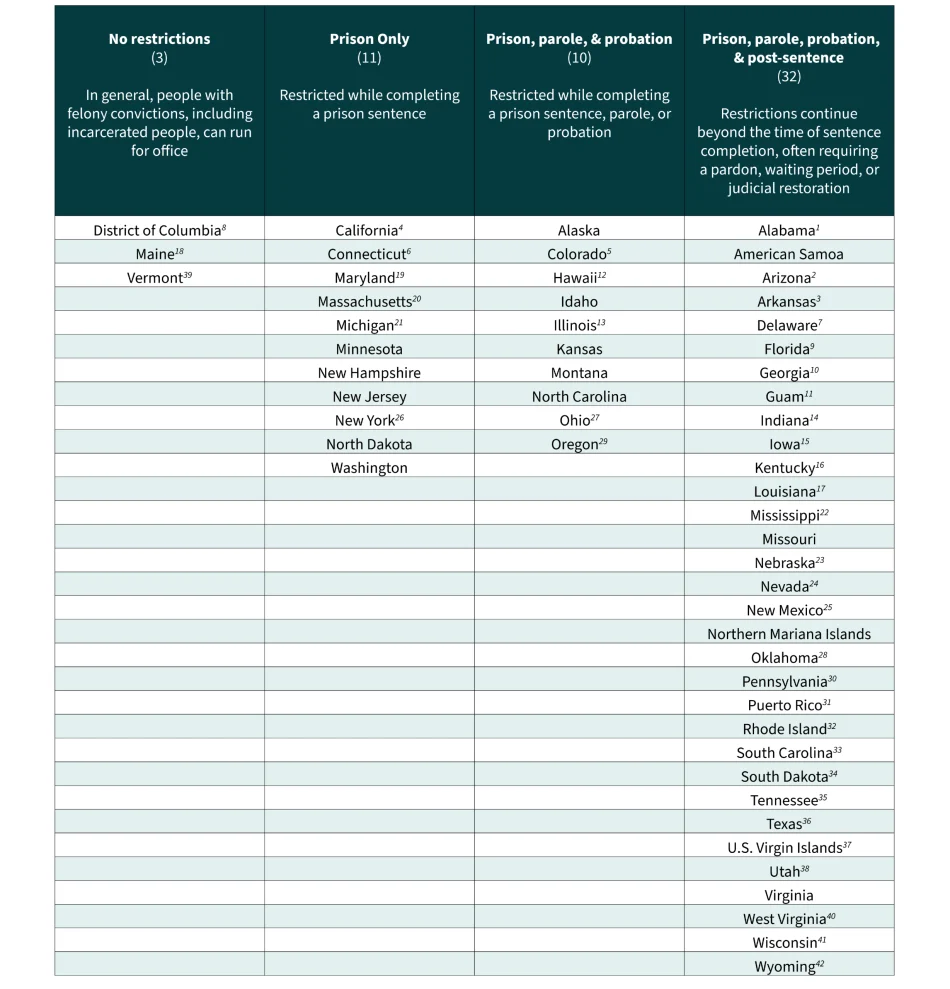
The Sentencing Project’s recent comprehensive analysis reveals a striking lack of uniformity in how jurisdictions treat civil rights restoration. While there has been significant momentum toward restoring voting rights—with 27 states and D.C. expanding access since 1997, allowing over 2 million Americans to regain their franchise—the right to run for office often lags behind.
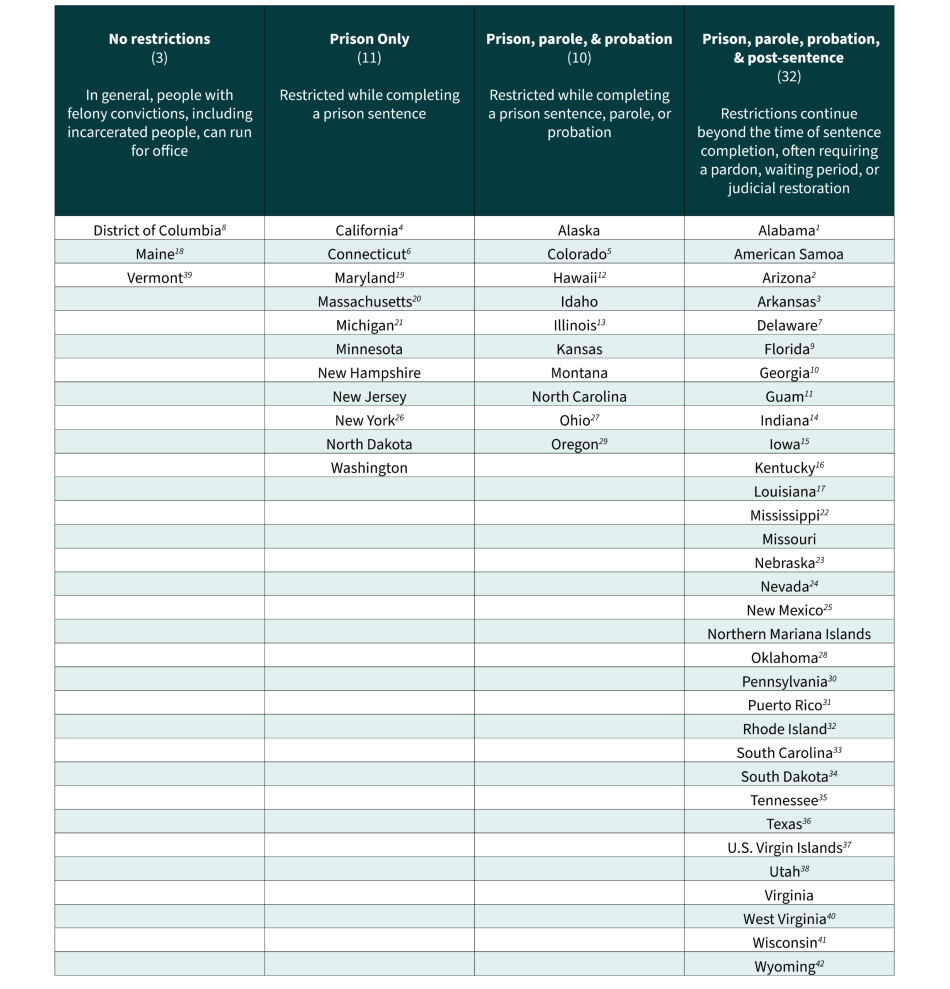
Data indicates that in 25 jurisdictions, the criteria for running for office largely mirror the criteria for voting. However, in 31 jurisdictions, the two are distinct, with candidacy requirements being significantly more rigorous. For instance, Missouri recently took steps to restore voting rights to individuals completing parole and probation; yet, those same individuals remain legally barred from seeking public office, even if they have been pardoned, provided their conviction involved a guilty plea.
Furthermore, many states maintain "breach of public trust" clauses. These statutes specifically disqualify individuals convicted of bribery, embezzlement, perjury, or the misuse of public funds from ever holding office again. While the intent is to protect the integrity of government, the scope of these laws is often so broad that it may exclude candidates whose offenses were minor or occurred decades prior.
Jurisdictional Variations and Ambiguity
The ambiguity surrounding eligibility often forces prospective candidates to seek costly legal counsel. In states like Nebraska, voting rights are restored automatically upon sentence completion, but a separate, arduous process—a pardon from the Board of Pardons—is required to run for office. Conversely, in Rhode Island, a "no contest" plea to a misdemeanor resulting in a sentence of six months can trigger a three-year ban from holding office.
In some cases, the restrictions are geography-dependent. Nebraska, for example, allows individuals with out-of-state felony convictions to run for office if their rights were restored in the state of conviction, but enforces stricter standards for its own residents. This "patchwork" creates a scenario where a person’s political future is effectively determined by state lines.
Policy Recommendations for Reform
The Sentencing Project and other criminal justice advocates suggest three primary pathways for reform to clarify and improve the current system:
- Elimination of Candidacy Bans: Advocates argue that the ultimate authority should rest with the voters. By removing blanket bans, jurisdictions allow the electorate to weigh a candidate’s past against their current platform and qualifications.
- Alignment of Rights: States should harmonize the criteria for voting and candidacy. The current practice of granting the right to vote but withholding the right to run for office creates a secondary class of citizens, which advocates argue undermines the goal of full civic reintegration.
- Public Guidance and Transparency: Given the complexity of current statutes, state election boards have an obligation to provide clear, accessible, and public guidance regarding who is eligible to run for office. Reducing legal uncertainty is essential for encouraging participation in the democratic process.
Broader Implications for Democracy
The debate over whether individuals with felony convictions should hold office touches upon fundamental questions regarding the purpose of the justice system. Proponents of reform suggest that if a person has served their time and paid their debts to society, they should be encouraged to contribute to the civic life of their community. Opponents, meanwhile, often emphasize the need for "public trust" and argue that certain offenses should permanently disqualify an individual from the responsibility of public stewardship.
As the number of justice-impacted individuals grows, and as more former inmates and those with records step forward to seek representation, the legislative bodies of the United States will be forced to grapple with these outdated, often contradictory laws. The ongoing evolution of these standards reflects a broader national conversation about the nature of rehabilitation, the meaning of citizenship, and the capacity of the American democratic experiment to encompass all voices, regardless of their past.
Ultimately, the trend toward electing justice-impacted individuals suggests a shift in public perception. By bringing lived experience to the halls of power, these officials are not only advocating for specific policy changes in housing and education but are also challenging the stigma associated with the criminal justice system. Whether this leads to a systematic overhaul of candidate eligibility laws remains to be seen, but the current movement marks a significant evolution in the American political landscape.