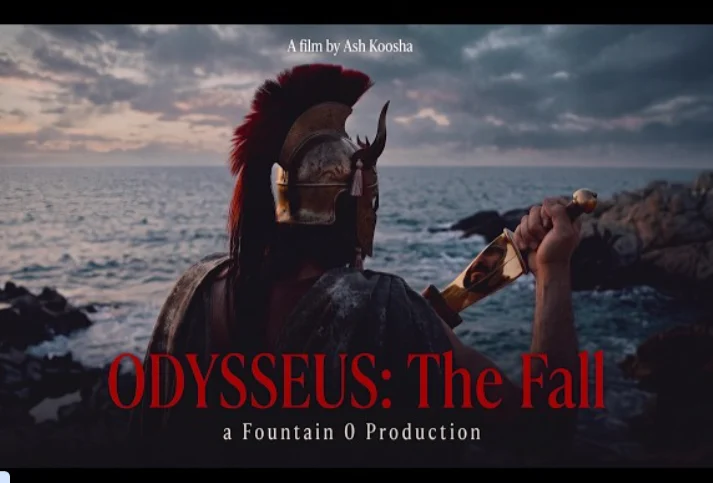
The landscape of modern cinematography is currently navigating a profound shift as the boundaries between traditional high-budget production and emerging synthetic media begin to blur. This evolution was brought into sharp focus recently following the announcement by Ash Koosha, an Iranian-born, British-raised engineer and filmmaker, regarding his upcoming 135-minute feature film titled Odysseus: The Fall. The project, created almost entirely using generative artificial intelligence, enters the public discourse at a moment of heightened sensitivity within the film industry, specifically as it parallels a massive $250 million production of The Odyssey directed by Christopher Nolan, slated for a Summer 2026 release.
The announcement of Odysseus: The Fall has sparked a significant backlash among industry purists and labor advocates, raising fundamental questions about the nature of authorship, the value of human performance, and the future of the cinematic medium. Koosha, alongside his brother Pooya and producer Tom Rogers—the founder of CNBC and a veteran media executive—is positioning this work not as a competitor to Hollywood’s blockbuster model, but as the vanguard of a new movement they describe as "tangential filmmaking."
The Technological and Economic Divide
The contrast between the two Odyssey projects serves as a stark case study in the changing economics of media. Christopher Nolan’s production represents the pinnacle of the "analogue" world: a massive capital investment, thousands of unionized crew members, A-list talent like Matt Damon, and a reliance on physical locations and practical effects. In contrast, Koosha’s Odysseus: The Fall was produced for a fraction of that cost—estimated in the low thousands of dollars—utilizing AI tools to generate imagery, sound, and sequence without a traditional set or a live cast.
This disparity has fueled the "end-of-cinema" narrative that has permeated Hollywood since the conclusion of the 2023 writers’ and actors’ strikes. During the promotion of the Nolan project, Matt Damon reportedly expressed a sense of finality regarding large-scale analogue filmmaking, suggesting that the current era of massive physical productions might be drawing to a close. Nolan countered this by labeling such views as "defeatist," yet the emergence of Koosha’s AI-generated feature suggests that the barrier to entry for epic-scale storytelling is rapidly dissolving.
From Human Rights to Epic Poetry: The Evolution of Ash Koosha’s Work
Ash Koosha is not a newcomer to the AI space. His previous work, Dreams of Violet, received a more sympathetic reception when it debuted at the Tribeca Film Festival earlier this year. That film utilized AI to depict the recent democratic protests in Iran—a subject matter that would have been impossible and life-threatening to film on location with a traditional crew. The use of synthetic media in that context was viewed by many as a necessary humanitarian tool, allowing a voice to be given to a movement that was otherwise suppressed.
However, the transition from humanitarian documentary-style filmmaking to the adaptation of Homeric epic poetry has changed the tenor of the conversation. Critics argue that while AI may have a place in activist filmmaking where physical access is denied, its application in the realm of classical adaptation—where it competes for the same intellectual space as major studio releases—is a provocation.
Koosha maintains that his intent is not to undermine the craft of directors like Nolan, whom he admires. Instead, he views AI as a tool for "painting with images and sound" that allows individuals to contribute to a larger cultural conversation. He likens the current state of AI filmmaking to the early days of blogging and the decentralized web, where independent voices began to coexist with established media conglomerates.
The Philosophy of Tangential Filmmaking
At the heart of the Koosha-Rogers venture, Fountain 0, is the concept of "tangential filmmaking." This philosophy posits that cinema should function more like modern discourse—fast, iterative, and accessible. In this vision, a major studio release like Nolan’s The Odyssey serves as the "main event," while AI-generated films offer alternative perspectives, theories, or stylistic interpretations of the same source material.
"Before these AI tools, if I had a theory about Odysseus, I could write a Substack about him," Koosha explained in recent discussions. "Now I can put my take into a film. I can paint my opinion with images and sound and light."
This approach suggests a future where the "monoculture" of a single definitive film adaptation is replaced by a plurality of visions. For Koosha, the goal is to democratize the scale of storytelling. Historically, only a handful of individuals with access to hundreds of millions of dollars could visualize an epic battle or an ancient civilization. AI potentially places those same capabilities in the hands of independent creators, regardless of their financial backing.
Chronology of the AI Cinema Controversy
The timeline of this friction highlights the speed at which the technology is advancing and the industry’s struggle to keep pace:
- May 2024: Dreams of Violet premieres at the Tribeca Film Festival, showcasing the potential for AI in activist filmmaking.
- June 2024: Reports surface regarding Christopher Nolan’s $250 million Odyssey project, sparking debates between Nolan and Matt Damon regarding the future of analogue film.
- July 2024: Ash Koosha announces Odysseus: The Fall, a 135-minute AI-generated feature based on the same source material.
- Late Summer 2024: The scheduled release window for Odysseus: The Fall, which the creators intentionally delayed to avoid "overloading" the audience and to allow for a clearer comparison with traditional methods.
Industry Reactions and the Question of Labor
The most contentious aspect of the AI filmmaking movement remains its impact on human labor, particularly actors and technical crews. Odysseus: The Fall famously features "no actors," a fact that has drawn the ire of labor advocates who see synthetic media as an existential threat to the acting profession.
Tom Rogers, producer and collaborator on the project, offers a different perspective. He argues that the rise of AI-generated content may actually increase the value of human performance. "I think this will make actors more valuable, whether it’s in an old-world movie or live theater," Rogers stated. The theory is that as synthetic "slop" or low-quality AI content saturates the market, the public will develop a higher premium for the "authentic" human presence, leading to a bifurcated market where both forms exist in parallel.
However, industry data suggests a more complex reality. According to recent reports on the state of the VFX and animation sectors, the integration of AI tools has already begun to shift hiring patterns, with a growing emphasis on "AI prompt engineers" and "technical directors" over traditional rotoscope artists or junior animators. The concern is that while "A-list" stars may remain protected by their brand value, the middle-class of the film industry—character actors, background players, and technical staff—may find their roles increasingly automated.
Analysis of Implications: A New Cinematic Era?
The emergence of Fountain 0 and projects like Odysseus: The Fall represents more than just a technological curiosity; it is a challenge to the gatekeeping mechanisms of Hollywood. For decades, the high cost of production served as a natural filter for which stories were told on a grand scale. By removing the financial barrier to "epic" filmmaking, AI introduces a level of volatility to the market that has not been seen since the transition from silent film to "talkies" or the shift from celluloid to digital.
The concept of tangential filmmaking also suggests a shift in how audiences consume media. If successful, it could lead to a "long-tail" model for cinema, similar to how YouTube or TikTok disrupted television. In this scenario, the "superior" film (as Rogers admits Nolan’s likely will be) retains its status as a cultural landmark, while the AI versions provide niche, experimental, or rapid-response alternatives.
Ultimately, the success of Odysseus: The Fall will depend on its ability to move beyond the novelty of its creation. While the "few thousand dollars" budget is an impressive feat of efficiency, the endurance of cinema has always relied on emotional resonance and narrative depth. Whether a synthetic Odysseus can capture the "nostos"—the painful homecoming—of Homer’s hero as effectively as a human-led production remains the central question of this experiment.
As the industry looks toward 2026, the coexistence of these two very different Odysseys will serve as a definitive litmus test for the future of the moving image. One represents the height of human-centric, resource-intensive art; the other, a democratic, software-driven expansion of the creative horizon. Whether they can truly flourish side-by-side or if one will inevitably eclipse the other is a drama currently unfolding in real-time.