The United States housing market is facing a renewed period of volatility as mortgage rates have once again breached the 7% threshold. This development marks a significant deviation from earlier 2026 economic projections, which had anticipated that mortgage spreads would act as a structural buffer, shielding the housing sector from the full impact of high-interest rates. However, a confluence of escalating geopolitical conflict in the Middle East, persistent inflationary pressure, and a hawkish pivot by the Federal Reserve has disrupted these expectations, creating a challenging environment for prospective homebuyers and market analysts alike.
The Geopolitical Trigger and Economic Headwinds
The current economic landscape is being dominated by the ongoing conflict involving Iran, now entering its seventh month. The stability of global energy markets has become inextricably linked to this regional instability, with crude oil prices hovering around the $100 per barrel mark. This elevated energy cost is exerting direct upward pressure on headline inflation, which remains stubbornly above the Federal Reserve’s target range.
Compounding this is the resilience of the domestic labor market. With an unemployment rate of 4.1% and jobless claims remaining at historically low levels, the economy continues to exhibit signs of robust nominal growth. While such data is traditionally a hallmark of a healthy economy, in the current context, it has provided the Federal Reserve with the mandate to initiate a new cycle of rate hikes. This move represents a strategic shift from the previous policy of interest-rate normalization, placing further upward pressure on the 10-year Treasury yield, which serves as the primary benchmark for mortgage pricing.
The 10-Year Yield and Mortgage Spreads
The relationship between the 10-year Treasury yield and residential mortgage rates is the heartbeat of the housing market. Under more stable conditions—absent the current geopolitical premiums—the 10-year yield would likely have traded within a range of 4.31% to 4.60%. This would have facilitated mortgage rates in the 6.25% to 6.50% range. However, the current reality has pushed yields higher, and market participants are now bracing for a potential move toward 8% mortgage rates if the geopolitical climate deteriorates further.
A move toward 8% would require the 10-year yield to test the 5.40% level, a threshold not seen since March 2002. Such a scenario is predicated on three key variables: an intensification of the conflict in the Middle East, a widening of mortgage spreads, and continued strength in economic data that would empower the Federal Reserve to maintain an aggressive stance. Mortgage spreads—the gap between the 10-year Treasury yield and the average 30-year fixed mortgage rate—have been widening in response to this uncertainty. Currently, these spreads are hovering near 1.97%, elevated above the historical norm of 1.60% to 1.80%, reflecting a risk-off sentiment among institutional investors who hold mortgage-backed securities.
The Case for Market Stabilization
Conversely, for mortgage rates to retreat toward the 6% range, a significant reversal in market sentiment is required. This would necessitate a de-escalation of the conflict, which would subsequently alleviate the pressure on oil prices. Historical data from the past three years indicates that whenever mortgage rates have trended toward 6%, it has been in direct response to the bond market pricing in a clear slowdown in the domestic labor market and broader economic activity.
However, the path to 6% has become steeper. Because the Federal Reserve is no longer in a rate-cutting cycle, the mechanism for lowering long-term yields has become more restrictive. Any movement toward lower rates would likely require a definitive cooling of the economy, a stabilization of trade relations, and a sustained decline in energy costs. Without these foundational shifts, the current base case for the remainder of the year suggests a range of 6.50% to 6.75% for mortgage rates, assuming the 10-year yield can stabilize near 4.48%.
Impact on Housing Market Activity
The correlation between mortgage rates and market volume remains clear: when rates exceed 6.64% and approach 7%, housing market activity experiences a measurable deceleration. Conversely, when rates dip below that threshold, transaction volume typically recovers.
Purchase Applications and Pending Sales
Purchase application data, which provides a 30-to-90-day window into future home sales, is already signaling a downturn. Recent reports indicate that while week-to-week fluctuations remain modest—often influenced by seasonal holidays like Labor Day—the year-over-year comparison reveals a stark decline. Purchase applications were reported down approximately 19% year-over-year, reflecting the higher hurdle rate now facing potential buyers. This is not merely a reflection of cost but of the psychological impact that high rates have on consumer demand.
Inventory and New Listings
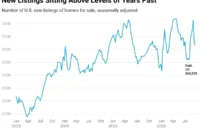
Housing inventory growth remains historically tame. While a lack of inventory is often cited as a cause for high prices, the current stagnation is partly due to the "lock-in" effect, where homeowners with low-interest-rate mortgages are reluctant to move and take on a new mortgage at current market rates. New listings have remained within a narrow range, typically between 80,000 and 100,000 per week during peak periods. Analysts note that for a true market correction or a significant increase in housing supply to occur, new listings would need to return to the levels seen in previous decades, which were often three to four times higher than current volumes.
Price Adjustments
The percentage of homes receiving price cuts has become a critical indicator of market health. Typically, about one-third of listed homes undergo a price reduction before closing. Data from the current cycle suggests that as mortgage rates have moved above 6.64%, the frequency of these price cuts has begun to climb. While national home price forecasts for 2026 have been relatively conservative—with some analysts calling for slight declines—the reality of sustained high rates may force a broader adjustment in property values. If wage growth continues to be outpaced by the combined impact of home prices and interest rates, affordability will remain the primary constraint on market growth.
Broader Implications and Outlook
The week ahead will be defined by three critical pillars: the evolution of the Iran conflict, upcoming commentary from Federal Reserve officials, and new home sales data. The recent escalation by the Houthis, including attacks on infrastructure in Saudi Arabia, has introduced a new layer of risk that has caught the attention of global markets. While there have been reports of diplomatic efforts by regional powers to temper the aggression, the volatility remains high.
For the Federal Reserve, the challenge is twofold: managing inflation without inducing a hard landing for the economy. Fed officials are expected to provide further clarity on the duration and intensity of the current rate-hike cycle. Market participants are closely watching these speeches to gauge the terminal rate and determine how long policy will remain restrictive.
As the industry looks toward the end of the year, the "base case" remains cautious. The housing market is currently caught in a transitionary phase, awaiting a signal that either the geopolitical risks have receded or the domestic economy has sufficiently cooled to justify a change in monetary policy. Until the 10-year yield finds a sustainable floor and mortgage spreads normalize, the housing sector is expected to remain in a period of restricted liquidity and diminished transaction volume. Stakeholders are advised to maintain a focus on long-term data trends rather than short-term weekly fluctuations, as the market navigates the complexities of a high-rate environment compounded by global instability.