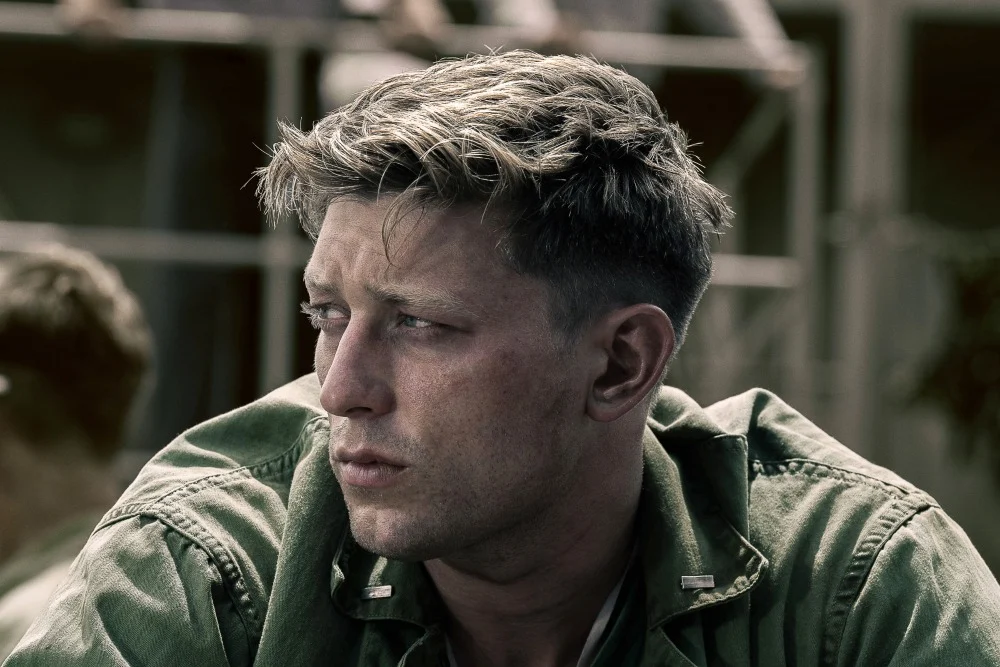
From the moment British stage breakout Tom Francis officially signed with Creative Artists Agency (CAA) in the United States, his professional trajectory was guided by a very specific, carefully curated ambition. Rather than casting a wide net across Hollywood’s vast casting landscape, the Laurence Olivier Award winner immediately drafted a shortlist of filmmakers he was determined to collaborate with. At the very pinnacle of that list sat Peter Berg, the acclaimed director behind gritty, character-driven dramas such as Friday Night Lights, Lone Survivor, and Patriots Day.
For Francis, whose meteoric rise has taken him from London’s West End to the stages of Broadway and into elite cinematic circles, working with Berg was not merely a career checkbox—it was a masterclass in visceral, grounded storytelling. That initial email to his representation has now materialized on the big screen, with Francis starring alongside an ensemble cast in Berg’s latest directorial effort, The Mosquito Bowl. Adapted from Buzz Bissinger’s meticulously researched 2022 non-fiction bestseller, The Mosquito Bowl: A Game of Life and Death in World War II, the film chronicles one of the most poignant, tragic, and astonishing episodes of the Second World War.
Set against the backdrop of the Pacific Theater, the movie tells the harrowing true story of a group of elite college football players who put their athletic glory on hold to serve as United States Marines. While preparing for the grueling and pivotal Battle of Okinawa, these young men famously organized and played an unsanctioned, fiercely contested tackle football game on Guadalcanal—an event that would come to be known historically as the Mosquito Bowl.
In the cinematic adaptation, Francis steps into the boots of David Schreiner, a legendary collegiate football star whose life was cut tragically short by the conflict. He is joined by a formidable ensemble cast portraying his fellow doomed teammates: Nicholas Galitzine as John McLaughry, Ray Nicholson as Tony Butkovich, and Bill Skarsgård as Bob Baumann. For Francis, the transition from theatrical productions like Sunset Boulevard to the dust, mud, and fire of a Peter Berg war film was both a daunting leap and a deeply supportive creative environment.
From West End Stardom to the Front Lines of Hollywood
Tom Francis’s journey to the cast of The Mosquito Bowl represents a swift and impressive crossover from musical theater and dramatic plays to major motion pictures. Prior to his cinematic endeavors, Francis captured international critical acclaim for his performance opposite Nicole Scherzinger in Jamie Lloyd’s radical reimagining of Sunset Boulevard. His tour-de-force turn earned him the prestigious Laurence Olivier Award for best actor in a musical, followed seamlessly by a Tony Award nomination for his triumphant Broadway debut.
His theatrical resume also boasts notable turns in iconic productions such as Rent, & Juliet, and Hair. However, Francis has increasingly proven his versatility across mediums. He made his feature film debut in Noah Baumbach’s highly anticipated project Jay Kelly and secured a coveted role in the fifth and final season of Netflix’s smash-hit psychological thriller series You. Yet, despite these rapid achievements, stepping onto the set of a Peter Berg production required a distinct shift in stamina and emotional availability.
Reflecting on the experience, Francis speaks candidly about the director’s unique leadership style on set. Getting the casting call, he notes, was a career-defining moment, but witnessing Berg’s creative process firsthand left an even more lasting impression. According to the actor, Berg operates with a rare combination of intensity and empathy, creating an atmosphere that feels less like a traditional corporate film set and more like an extended family. In moments of professional and personal vulnerability, Berg has reportedly served as an unwavering anchor for his cast members, offering a level of warmth, honesty, and open communication that translates directly into the raw authenticity of his films.

Unscripted Moments: Showcasing Hidden Musical Chops
One of the more unexpected developments during the production of The Mosquito Bowl involved a last-minute creative pivot by the director. In real life, David Schreiner was a dedicated athlete and a dedicated Marine, not a professional vocalist. However, aware of Francis’s formidable musical background—honed through years of commanding top-tier theatrical stages—Berg decided to weave a touch of the actor’s real-world talents into the fabric of the historical narrative.
The result is an impromptu, deeply atmospheric sequence added to the film’s first act. Shortly before the collegiate athletes are formally deployed to the Pacific Theater, the characters gather in a local tavern for a final moment of camaraderie, music, and fleeting normalcy. Francis recalls receiving sudden instructions from the director regarding a specific musical number.
Berg approached the actor with a song, instructing him to learn the piece overnight for filming the following morning. Initially anticipating a casual, intimate acoustic moment—perhaps strumming a guitar around a rustic campfire—Francis arrived on set to discover a fully staged, elaborate musical sequence set within the confines of a period-accurate bar. The spontaneous addition not only highlights Francis’s unique skill set but also provides a poignant, heartbreaking juxtaposition to the devastating brutality that follows once the men reach the battlefield.
Historical Context: The Real Tragedy of the Mosquito Bowl
Buzz Bissinger’s source material details an extraordinary chapter of American sports and military history. In the autumn of 1944, the 4th Marine Regiment and the 29th Marine Regiment were stationed on Guadalcanal, undergoing intensive amphibious warfare training ahead of the imminent invasion of Okinawa. Among the ranks were dozens of former All-American and collegiate football stars who had traded their Ivy League jerseys and powerhouse university stadiums for the olive-drab utility uniforms of the United States Marine Corps.
On Christmas Eve in 1944, amid oppressive tropical humidity and the ever-present threat of enemy combatants, these men organized a tackle football game. Played on a makeshift field hacked out of the jungle—complete with coral reefs threatening torn ligaments and makeshift goalposts—the contest featured some of the greatest athletic talents of the era playing with ferocious, reckless abandon. For a few brief hours, the horrors of war were suspended as the players relived their glory days on the gridiron.
However, the narrative of the Mosquito Bowl is defined less by the final score of the football game and more by the staggering casualty rates that followed. The ensuing Battle of Okinawa, which commenced in April 1945, stands as one of the bloodiest and most fiercely contested campaigns in the Pacific Theater of World War II. True to the heartbreaking historical record, out of the four central figures depicted in Berg’s film—Schreiner, Butkovich, Baumann, and McLaughry—only John McLaughry survived the relentless carnage of the war.
Rejecting Hollywood Glamour for Brutal Historical Accuracy
In bringing this harrowing history to the screen, Berg and cinematographer Jacques Jouffret made a conscious, uncompromising decision to strip away any traditional cinematic romanticism often associated with Hollywood war pictures. Rather than framing combat through a glossy, heroic lens, the production sought to replicate the terrifying, chaotic, and destructive nature of modern warfare in the Pacific.
Francis recounts pivotal conversations with Jouffret regarding the film’s visual tone and aesthetic philosophy. The cinematographer made his intentions explicitly clear to the cast early in production, emphasizing that the objective was never to beautify the tragedy. While the production acquired massive shipments of tropical foliage to authentically recreate the island environment, Jouffret opted to scorch and obliterate the scenery rather than showcase pristine palm trees. Every visual choice was engineered to reflect the brutal, unsparing reality of what the real Marines endured.

This visceral approach extends to the film’s pacing and editorial tone. Francis acknowledges that viewing the finished product can be genuinely uncomfortable for audiences, designed intentionally to provoke unease rather than passive entertainment. By confronting viewers with the graphic horrors of the battlefield, the filmmakers aimed to honor the true sacrifices made by a generation thrust into global conflict at an exceptionally tender age.
Commemorating a Lost Generation
A striking element of The Mosquito Bowl’s narrative structure arrives during the film’s somber end credits, where the production explicitly lists the ages of the real-life soldiers. Every single one of the primary subjects was merely 24 years old when they made the ultimate sacrifice in the Pacific.
Reflecting on the sheer youth of the men he portrayed, Francis expresses profound reverence for the wartime generation. At just 24 years old, these individuals possessed entire lifetimes ahead of them—futures defined by families they were forced to leave behind, careers left unstarted, and communities waiting for a homecoming that would never materialize. The actor notes that the sobering realization of their youth instilled in him a deep, enduring respect not only for the veterans of World War II, but for every generation called upon to shoulder the burdens of history.
Looking Ahead: The Return to the Stage and Silver Screen Aspirations
As The Mosquito Bowl makes its theatrical run ahead of an anticipated global streaming premiere on Netflix on November 25, Francis is already casting his gaze toward his next creative challenge. While his transition to film has proven remarkably successful, the actor admits to missing the distinct, high-stakes adrenaline rush of live theatrical performance.
Looking forward, Francis harbors a strong desire to return to the stage, specifically originating a role in a brand-new play rather than stepping into an established revival. Having spent significant portions of his early career stepping into beloved, pre-existing shoes, he expresses an intense artistic hunger for the deep sense of ownership and authorship that comes with building a character from scratch for the very first time.
Yet, even as he plans his eventual return to the theater, Francis remains firmly enamored with the world of cinema. With a major role in one of the most talked-about historical dramas of the year, a burgeoning filmography, and a solidified spot on Hollywood’s radar, Tom Francis has firmly established that his transition from theatrical icon to major cinematic force is only just beginning.